SpaceX at theCrossroads
 NETOKYO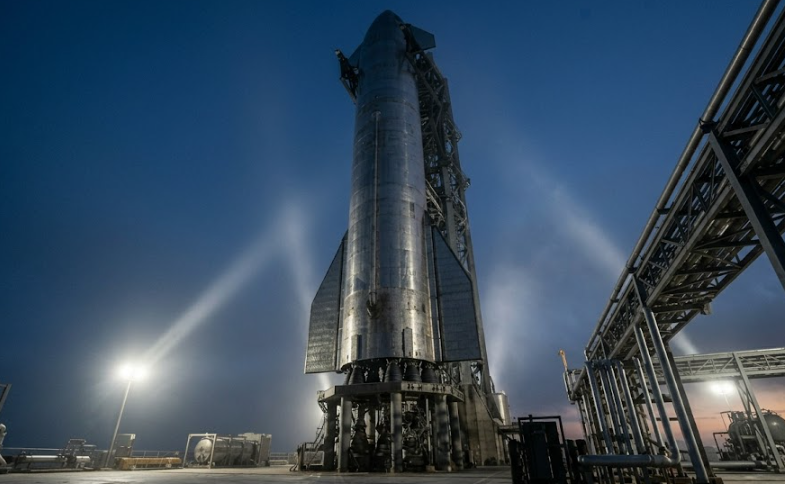
SpaceX at the
Crossroads
Starship V3 flew. The S-1 dropped. The IPO is loading. Everything SpaceX has been building toward is happening at once — and the world is watching.
In the span of five days, SpaceX filed for what could be the largest IPO in history, launched and landed the most powerful rocket ever built in its new V3 form, and revealed for the first time just how much money — and how many losses — sit beneath the surface of Elon Musk's empire. This is not a normal week for a space company.
01 — Starship V3: Flight 12 Debrief
On May 22, 2026, SpaceX launched Starship Flight 12 from Starbase, Texas — the first flight of the entirely redesigned Starship Version 3, and the first launch from the new Pad 2. After a scrubbed attempt on May 21 due to pressure issues in the Ship quick disconnect, the rocket lifted off at 10:30 p.m. local time and did not disappoint.
Flight 12 — Mission Summary
- Ship 39 (Starship V3) reached its planned suborbital trajectory and completed a controlled splashdown in the Indian Ocean — as planned.
- Ship deployed 22 Starlink simulators, including two camera-equipped satellites that imaged the heat shield during reentry.
- Ship completed a Raptor engine relight in space and survived reentry despite losing one Raptor Vacuum engine during ascent.
- Super Heavy booster B19 failed to ignite its boostback burn properly, crash-landed in the ocean instead of a controlled recovery — the mission's main setback.
- Elon Musk called the flight "epic" on social media.
The V3 architecture brings sweeping changes: Raptor 3 engines with higher thrust and simplified design, a novel fuel system in the booster, only three larger grid fins replacing the previous six, an integrated hot-staging system removing the expendable interstage, and significantly increased propellant capacity. SpaceX also tested intentional heat shield tile removal to study cascading damage — the kind of data that makes future crewed missions safer.
Developmental testing by definition is unpredictable. But by putting hardware in a flight environment as frequently as possible, we're able to quickly learn and execute design changes.
— SpaceX, pre-launch blog post, May 2026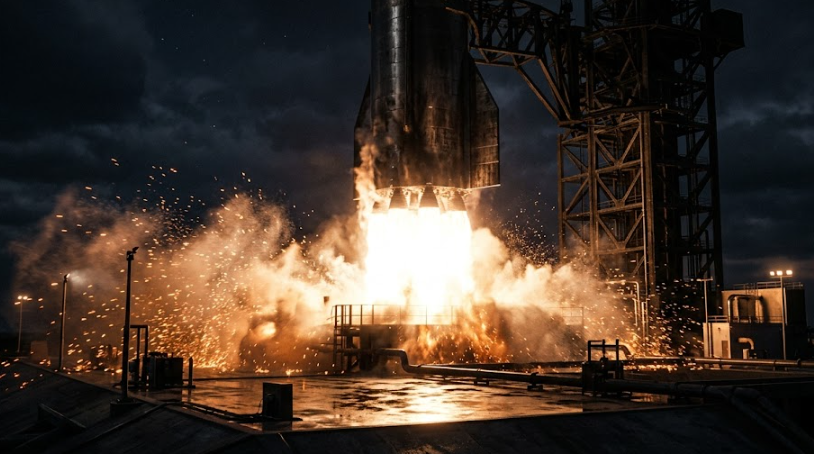
02 — The S-1 Drops: SpaceX Goes Public
On May 20 — one day before Flight 12's first attempt — SpaceX publicly filed its S-1 registration statement with the SEC. For a company that had kept its finances entirely private since its founding in 2002, this was a seismic disclosure. The numbers inside are both impressive and complicated.
Up 33% year-over-year from 2024
+49.8% YoY. 61% of total company revenue
As of March 2026; doubled in one year
Largest constellation in human history
Would surpass Saudi Aramco's 2019 record
Including $20B bridge loan maturing 15 months post-IPO
The Starlink connectivity segment alone generated $3.26 billion in Q1 2026 — profitable at an operating level of $1.19 billion. The picture for the AI segment, however, is starkly different: SpaceX's newly acquired AI division (incorporating xAI and rebranded "SpaceXAI") posted a $2.47 billion operating loss in Q1 2026 alone, and a $6.36 billion loss for all of 2025.
Key Disclosure: Anthropic Deal
The S-1 revealed that Anthropic — the AI safety company — will pay SpaceX $1.25 billion per month for access to AI computing infrastructure through May 2029. That's a $15 billion annual contract, nearly matching the combined revenue of SpaceX's Space and Connectivity businesses.
Elon Musk controls 85.1% of combined voting power through Class B shares, meaning minority shareholders will have virtually no say in corporate direction. The IPO, targeted for listing as early as June 12, 2026 on a yet-to-be-confirmed exchange, would raise an estimated $30 billion.
03 — The Moon Mandate:
Artemis, Starship, and the Race to the South Pole
To understand why Flight 12 carried weight far beyond a test flight, you need to understand NASA's Artemis program — and precisely how much of it depends on Starship working.
In 2021, NASA awarded SpaceX a $4.05 billion contract to develop two human-rated Starship vehicles as its Human Landing System (HLS) — the craft that will carry astronauts from lunar orbit down to the surface of the Moon. The prize: delivering the first woman and the first person of color to walk on the Moon, at the lunar South Pole, a region that harbors permanently shadowed craters believed to contain billions of tons of water ice. That ice is not just scientifically significant. It is rocket propellant. It is oxygen. It is the foundation of any future permanent lunar base.
The Artemis Roadmap — Current Status
- Artemis II (targeted April 2026): First crewed flight of Orion around the Moon — no landing. Four astronauts, lunar flyby. On track.
- Artemis III (2027 target, widely considered ambitious): First crewed lunar landing since Apollo 17 in 1972. Requires Starship HLS to be fully qualified. Timeline under pressure.
- Artemis IV (late 2028): Second crewed landing, near the South Pole. NASA intends to use an enhanced Starship HLS. The Lunar Gateway outpost begins assembly.
- Permanent lunar outpost by 2032: NASA's stated goal. Staging point for Mars.
The critical dependency — the one that links Flight 12 directly to astronauts walking on the Moon — is orbital refueling. Starship HLS cannot carry enough propellant from Earth to reach the Moon's surface and return. The solution: build a propellant depot in low Earth orbit, fill it with up to 10 or more tanker launches of liquid methane and liquid oxygen, then transfer that fuel to the HLS Starship before it departs for the Moon.
The Starship lunar lander will need to be refueled in space up to 12 times to pack away enough propellant to land on the moon and launch back to lunar orbit.
— SpaceX internal document, obtained by Politico, 2025This "gas station in space" architecture is unlike anything ever attempted at scale. SpaceX is targeting June 2026 for the first integrated orbital refueling demonstration — two Starships docking belly-to-belly in low Earth orbit, one transferring cryogenic propellant to the other. A "target" Starship launches first. Three to four weeks later, a "chaser" Starship rendezvouses, docks, and transfers fuel. Then both deorbit.
If that demonstration succeeds, an uncrewed Starship lunar landing — a full dress rehearsal at the Moon — is targeted for June 2027. Only after that can NASA authorize astronauts to descend to the surface. The earliest a crewed Moon landing could occur under SpaceX's own internal timeline: September 2028.
What Starship Still Has to Prove Before Humans Land on the Moon
- ✦ Orbital flight — a full orbit of Earth (not yet achieved; Flight 12 was suborbital)
- ✦ Cryogenic propellant transfer — docking two Starships in orbit and transferring liquid methane / LOX in microgravity (targeted June 2026)
- ✦ Uncrewed lunar landing — landing Starship HLS on the Moon's South Pole without crew (targeted June 2027)
- ✦ Liftoff from lunar surface — launching from the Moon back to orbit
- ✦ Docking with Orion — rendezvousing with NASA's crew capsule in lunar orbit to transfer astronauts
Flight 12 checked none of those boxes directly. What it did prove is that Starship V3's propulsion, thermal protection, and avionics architecture is fundamentally sound enough to fly — and survive — without all engines firing perfectly. That is the foundation. Everything else has to be built on top of it, and the clock is running.
04 — The Mars Equation:
Musk's 50/50 Bet on 2026
The Moon, for Elon Musk, is not the destination. It is a waypoint. The destination — the one he has described as the core reason SpaceX exists — is Mars. And the 2026 Earth-Mars transfer window, which opens in November and closes in December, represents the next opportunity to try.
In a video posted to X in mid-2025, Musk gave his company a 50-50 chance of launching an uncrewed Starship to Mars by late 2026. He was explicit: the entire timeline hinges on whether Starship can master orbital refueling. Without propellant transfer in Earth orbit, a Mars trajectory is impossible — the fuel required simply cannot be launched in a single vehicle.
The Mars Mission Architecture — As of May 2026
Late 2026 (target, 50/50 odds): Up to five uncrewed Starships launch during the Earth-Mars transfer window. First flights carry Tesla Optimus humanoid robots as simulated crew — to test life support, landing systems, and surface operations autonomously.
~2028 (if uncrewed missions succeed): First crewed Starship missions to Mars. Musk's stated goal: not a flags-and-footprints visit, but the beginning of permanent settlement infrastructure.
Long-term vision: 1,000 to 2,000 Starships launched every two years, exponentially growing toward a self-sustaining city of one million people on Mars within approximately 20 years.
There is a tension embedded in this timeline that the S-1 filing does not resolve. SpaceX's internal documents — reported by the Wall Street Journal — suggested the company had privately told investors it would "prioritize going to the Moon first" and attempt Mars at a later time, effectively stepping back from the aggressive 2026 Mars target. Publicly, Musk has not formally abandoned the 2026 window. Privately, the engineering dependency is clear: orbital refueling must be proven before either the Moon landing or a Mars departure is attempted.
If the orbital refueling demo planned for June 2026 succeeds, the 2026 Mars window becomes theoretically plausible. If it slips — as many milestones in Starship's development have before — the next Earth-Mars alignment is late 2028. Musk himself acknowledged: "If Starship were not ready by that time, SpaceX would wait another two years before trying again."
Being multiplanetary will vastly increase the probable lifespan of consciousness, as we will no longer have all our eggs, literally and metabolically, on one planet.
— Elon Musk, X post, September 2024What makes 2026 uniquely high-stakes is the convergence: the IPO, the orbital refueling demo, the potential Mars window, and the Artemis schedule pressure all fall within the same twelve-month band. SpaceX has never had this much riding on a single year's performance. Flight 12 was the opening shot.
05 — Starlink: The Machine
That Funds Everything
To understand how SpaceX can simultaneously fund Starship development, an AI division burning billions, and a Mars program, you have to understand Starlink — and how radically its economics have changed in three years.
In 2022, Starlink was a promising but money-losing satellite internet service with a few hundred thousand subscribers and significant hardware subsidies per terminal. By the end of Q1 2026, it had 10.3 million subscribers across more than 100 countries, generated $3.26 billion in a single quarter, and operated at a 63% adjusted EBITDA margin — comparable to the best software businesses in the world, running on a constellation of nearly 10,000 satellites in orbit.
2024 to 2025, year-over-year
Total subscribers doubled in one year
Up 86% from 2024
Best-in-class, comparable to top SaaS
Starlink works because SpaceX is its own launch provider. Every Falcon 9 that lifts a batch of Starlink satellites costs a fraction of what a competitor would pay for equivalent capacity — because the rocket, the launch pad, and the integration are all internal. Reusability compounds this advantage: a Falcon 9 first stage has now flown more than 25 times in some cases, amortizing the manufacturing cost across dozens of missions. The more Starlink grows, the more launch capacity SpaceX needs. The more launch capacity SpaceX runs, the cheaper each unit becomes.
This flywheel is what makes SpaceX's IPO valuation simultaneously defensible and extraordinary. A $1.5 trillion target implies investors are pricing not just Starlink's current cash flows, but its trajectory: projected revenue of $22–24 billion in 2026, with Starlink expected to account for roughly 79% of total company revenue as Starship development costs drag the Space segment into operating losses.
06 — The AI Wildcard:
SpaceXAI and the $15B Anthropic Bet
The most surprising disclosure in SpaceX's S-1 was not the Starlink numbers — analysts had modeled those for years. It was the AI segment. SpaceX's acquisition of xAI (Elon Musk's artificial intelligence company, maker of the Grok chatbot) and its rebranding as "SpaceXAI" revealed a business that is simultaneously massive in ambition and deeply in the red.
The AI segment posted a $6.36 billion operating loss in 2025 and a further $2.47 billion loss in Q1 2026 alone. Yet the S-1 frames SpaceX primarily as an AI company — the filing uses AI-related terms in 47% of segment-specific language and allocates 93% of the company's stated $28.5 trillion TAM to AI-related markets.
The Anthropic Contract — What It Means
Anthropic — the AI safety company behind the Claude family of models — will pay SpaceX $1.25 billion per month for access to AI computing infrastructure through May 2029. Annualized, that is $15 billion per year: nearly equal to SpaceX's entire 2025 non-AI revenue. The deal reveals that SpaceX's orbital data center ambitions — satellites in Sun-synchronous orbit running AI inference workloads — already have a customer paying at scale.
The strategic logic is coherent even if the losses are eye-watering: Starlink provides global low-latency connectivity. Orbital compute satellites (deployment targeted 2028) provide the processing layer. xAI / SpaceXAI provides the model layer. In Musk's vision, SpaceX becomes the infrastructure backbone of a planetary AI network — one that operates above national borders and is accessible anywhere a Starlink terminal can see the sky.
Whether that vision justifies the losses depends on execution timelines that no S-1 can guarantee. What the filing makes clear is that Starlink profits are currently subsidizing everything else — Starship, SpaceXAI, Mars ambitions, and the $20 billion bridge loan that comes due 15 months after the IPO.
07 — A Week in History: Timeline
2026
2026
2026
2026
2026
(Target)
(Target)
(50/50 odds)
(Target)
(Vision)
08 — What Could Go Wrong:
The Honest Risk Register
SpaceX has defied skeptics consistently enough that dismissing its timelines has become an embarrassing habit for analysts. And yet, intellectual honesty requires acknowledging where the cracks could form.
Key Risk Factors — As of May 2026
- Orbital refueling has never been done at scale. Transferring cryogenic propellants between two large vehicles in microgravity involves boiloff management, leak control, and docking precision that no one has demonstrated in this configuration. The June 2026 demo is genuinely uncertain.
- Super Heavy recovery remains unresolved. Flight 12 lost its booster. The "Mechazilla" chopstick catch system has worked before, but the boostback burn failure in Flight 12 represents a regression that must be understood before V3 can claim reliable reusability.
- The $20 billion bridge loan matures 15 months post-IPO. If Starlink growth decelerates or capital markets turn, the refinancing pressure on SpaceX becomes acute. The S-1 omits subscriber churn rates — a conspicuous absence for a subscription business valued in the hundreds of billions.
- Regulatory exposure is underappreciated. SpaceX is permitted up to 25 Starship launches per year from Starbase under current FAA authorization. Scaling to the cadence Starship needs for Moon and Mars missions requires regulatory relationships that are currently politically contingent.
- Musk's attention is finite. Tesla, xAI, X (formerly Twitter), The Boring Company, and Neuralink all compete for the same founder's focus. SpaceX has historically performed best when it was his primary obsession.
None of these risks are fatal. All of them are real. The SpaceX that filed its S-1 in May 2026 is structurally stronger than any version of the company that came before — Starlink's cash generation provides genuine insulation against near-term volatility. But the margin for timeline error narrows significantly once public shareholders are watching quarterly earnings calls.
NETOKYO Perspective
SpaceX is no longer a rocket company. It is a civilization-scale infrastructure project that happens to be run out of a coastal town in South Texas. The S-1 makes this explicit: Starlink funds the Moon program. The Moon program validates the Mars architecture. The Mars architecture justifies a $1.5 trillion valuation. The $1.5 trillion valuation finances the AI orbital compute layer. The AI compute layer monetizes the Starlink network. It is a flywheel that no single company has ever attempted to spin at this scale.
What is genuinely new about May 2026 is that the flywheel is now visible. For the first time, investors, engineers, and governments can read the actual financials — not estimates, not leaks, but audited numbers. Starlink is real and profitable beyond most projections. The AI losses are real and larger than many expected. The Artemis dependency is real and the timeline pressure is acute. Flight 12 proved V3 can fly. The S-1 proved SpaceX can be scrutinized.
For Tokyo, none of this is distant. Japan's disaster response networks, maritime communications, and remote island connectivity increasingly run on Starlink. JAXA and Japanese aerospace manufacturers are embedded in the supply chains and mission architectures that Artemis and commercial space are reshaping. The question of who controls the infrastructure of the next half-century of human space activity is being answered right now — in a courtroom-sized window between Starbase and the SEC.
Flight 12 proved V3 can survive space. The S-1 proved SpaceX can survive scrutiny. The orbital refueling demo will prove whether the Moon plan is real. And the 2026 Mars window — 50/50, by Musk's own admission — will tell us whether the biggest bet in the history of private enterprise is a plan or a prayer.
\ 最新情報をチェック /